Saturday, 25 May 2013

Late May, fast growth

May - Fast Growth

It is amazing how much  everything has grown in the 19 days 
since I last posted pictures.

You may wonder about the red & green plastic sheets hung up.
The green one on the outside was put there to give a bit of shade 
as the temperature inside reached 40c/104f one day and the peas 
sure were NOT happy about it.
The red on the inside wall - well, in the Lee Valley Tools catalogue
they offer re plastic sheeting to use as ground cover around your 
tomato and other plants to help promote fruit production.  I have
carrots planted between the tomatoes (companion planting) so I was
unable to use the plastic on the ground.  Instead, I decided to try some
on the wall to see how it would do there.  (I found a red plastic table cloth
at the dollar store that was the right size.) 

Potted flowers in back yard have been swamped by the pansies

* * *

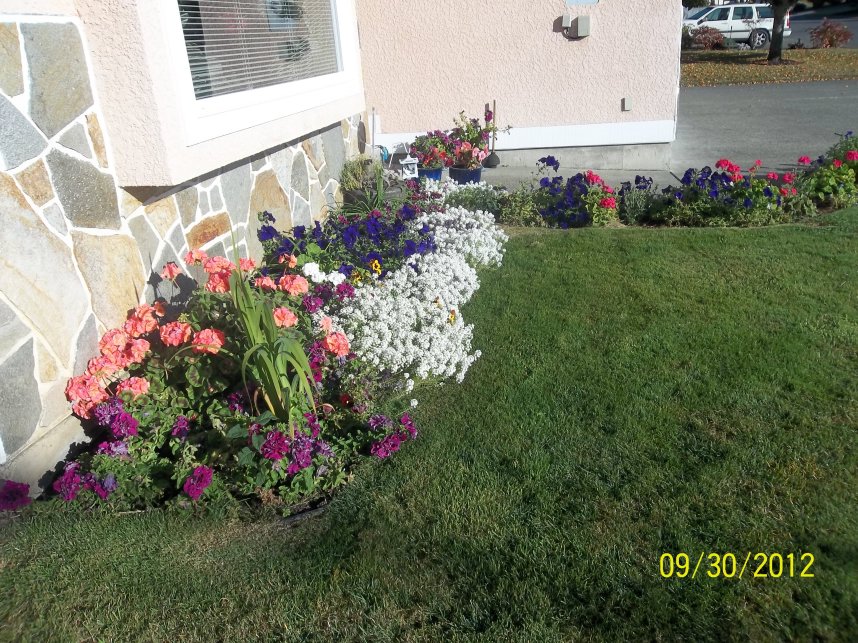
The front flower beds are slowly filling in.  The white flowers are Alyssum that self-seeded.

* * *

 Volunteer potatoes want the whole bed!   Strawberries are loaded, raspberries also
bearing a good crop with lots of bumble bees busy pollinating.

* * *

Inside the greenhouse the "bush" peas have reached the roof and want to keep going.
Another week and we will be eating peas.  
The lettuce seems to be going crazy and not wanting to form heads.

 * * *

In the pictures posted May 6th the tomato plants were about 1/3 the size
they are now.  I keep the sucker shoot pruned off and the plants are doing great.
I saved 4 sucker shoots that were about 3" long, trimmed the bottom leaves,
then potted them and kept the soil very moist.  They developed nice roots and
have found homes elsewhere as I have enough plants.
 * * *

Beware of the dog!

I don't think she has reached 7 pounds yet but she has a good voice!  

Regards to all
GG  


Saturday, 11 May 2013

May update - Warmer weather!

Well, the warm weather is with us, so that means more  planting of flowers as well as setting out some seedlings in the veggie garden.  It got so hot inside the greenhouse that some of the peas got burned at the tops.  The temperature reached 104f/40c so I had to hurriedly arrange for some shade.  Doesn't look pretty, but it does the job.  Shade cloth that we brought back from Arizona on the roof and a thin plastic table cloth on the outside of the wall.  It did the trick!
 
In the front bed in the right corner is a single "Sweetmeat" squash plant.  Last year 3 were more than we needed and they just about smothered the whole bed.  Left end of the bed is a chive plant. The large green plants are volunteer potatoes.  (works for me!)
In the next bed are strawberries.  A real jungle, loaded with blooms, strawberries are forming nicely.  The white is plastic pipe framework holding up a mesh to keep birds out.
The far bed is my tangle of raspberry canes.  I think we planted 8 canes last year and they have done quite well (to put it mildly)... I have already given away a few dozen runner shoots and there are many dozen left to sort through and see which I will leave in the bed and which I will dig up and offer them to other people.
 * * *

 Bottom left you can see dark lines in the dirt which are rows of beets just planted and not yet sprouted.  Working towards the far end, next are the last 2 lettuce plants from the ones planted by our Saskatchewan friends before we got home.  Next, barely in sight are some small lettuce plants I started in paper pots and then next to the peas are some lettuce plants we started in pots then set them out in the greenhouse.  As you can see, the peas are right up to the ceiling - I had to top them so they didn't push against the plastic.  In the far left corner hidden away are the inside strawberry plants which are loaded with berries but none ripe yet.  Also in the corner are about 8 raspberry canes that came under the wall and are trying to take over.  Just for fun I am going to let them grow there (I will have to top them when they get near the ceiling) so I can see if they do OK inside, maybe produce fruit sooner than outside.
On the right side are 5 tomato plants.  A couple of "Early Girl", a "Celebrity" and 2 "Super Fantastic"...  all good producers.  On the right bottom corner are a couple of bush beans that are now producing flower buds.
* * *

 Below you can see the Super Fantastic tomato plant and the bush beans with the Egyptian Onions in the corner quietly going crazy.


B

* * * 
One corner of the greenhouse has been temporarily turned into a "nursery" for seedlings or small plants.  If you look carefully you can see 4 tomato plants that are busy setting roots.  They are the suckers taken from my main plants.  I wait until the sucker shoots get a few inches long then nip them off the main plant (where the leaves grow off the stem), I then nip off the largest leaf branch from the sucker and just put the stem in nice moist dirt.  Keep them moist and they send out roots and you have more plants in no time at all.  I have enough plants so these are for our 93 year old neighbour who is still gardening!  
In the big pot is a hydrangea taken from one we moved.  It looks like it is going to do OK as it has been in the pot about a month now so should have some good roots on it.  The pot in the middle with the pink flowers contains some strawberry plants - ornamental type with pink flowers and they do produce fruit but very small and very sweet.  (Gift from our 93 year old neighbour!)  In the plastic tray are some scarlet runner bean seeds in shallow dirt.   When they start to sprout I will then plant them out on my bean trellis/teepee.  Doing this way I know for sure if the seed is growing rather than wait and find out which ones don't germinate.  In the segmented pot are seeds of "Bee  Balm" - the claim to fame is the flowers attract humming birds as well as bees.
 
* * *

So much for the veggies  -  below are a few pictures of the flower gardens.  Still a work in progress and before long they will put on a good show.
 Just starting to look decent - the geraniums are mostly in bud, pansies still small, and the hundreds (yes hundreds) of Alysum plants are just starting to bloom.  They are self-seeders from last year.


 * * *
 The bed next to the south fence is just starting to look good.  The pink Azelia is the main feature at the moment with the peony (bottom left) in bud.  Not sure if it is going to do much in the way of large blooms as we moved it this spring.  Our 2 small Rhododendrons are not happy, possibly due to my not knowing they don't like mushroom manure.  Also in this bed are a couple of Oriental Poppies (the ones our puppy is named after)... as well as some iris, day lillies & a new plant that is a double bloom Columbine (also said to attract humming birds)...

 * * *

Last but not least are the planters by the patio next to the gazebo.  The pansies are the main bloomers at the moment but other "stuff" will be coming on in a while.

I hope you are enjoying the spring as much as we are!

GG
 

Thursday, 25 April 2013

SPRING GROWTH UPDATE

SPRING GROWTH UPDATE

Since it has been about 6 weeks or so since my last posting I guess it is time to show a few pictures of how things have changed.  To compare you will have to look at my March 6th posting and how much growth in what seems like no time at all!

Not much doing in the large bed, chives growing and a couple of volunteer potatoes but that is all.


The strawberries have bushed out nicely and are in bloom.


I am blown away by the amount of growth the raspberries have produced.  Shoots came out from under the raised bed and I have dug up probably 3 dozen or so and given them away.
 

 The Egyptian onions (AKA Walking Onions) have done  amazingly well and are forming the onion clusters at the end of the stalks.


 Bush beans - yes, just TWO!  Last year we had so many beans we couldn't keep up with them and gave away bags of them.  This year I decided to go the other way - the "Royalta" or purple bush bean is so prolific that two plants will give us enough beans for a weekly feed or two.  Also I will be planting a couple more spaced out a bit so they come on when these start to get tired.  Not sure if this is necessary as the plants produced right until frost last year.


 What was very small lettuce has mostly been eaten with just a few plants left.


 These are plants started in home-made newspaper pots - I put 2 seeds in each pot in hopes at least one will survive.   One has 2 growing and they will both grow to a good size in not many weeks.


 Last posting showed a few raspberry canes pushing up under the landscape ties and into the greenouse.  They were barely visible in the last picture and are now about 2 feet tall.
In the foreground is a strawberry that was a runner from the ONE plant I put in the greenhouse last year.  Between the strawberry and the raspberries here you can see another plant.  It is a gift someone gave us in return for some plants we offered on "Freecycle".  It is Oregano, and it is growing like a weed!  I have already given 5 or 6 plants that were branches that touched the ground and rooted.  Smells like pizza!


 Looks strange - but this is the subs of lettuce that we have harvested.  You can just make out the little green shoots - I am hoping the shoots will develop into more lettuce as it should grow back quicker than from seeds or seedlings.


 In the foreground are some "Sweetmeat" squash from seed we saved.  The last squash from last year was finally cut up and eaten about a month ago.  In the background are 3 tomato plants.  One is "Celebrity" and the 2 far ones are "Early Girl",  both varieties do quite well in the greenhouse.  When buying potted tomato plants you sometimes find 2 together in one pot.  If you are careful you can separate the 2 and get 2 plants for the price of 1...


Just HAD to give you a close-up of the developing strawberries.  We are eagerly looking forward to the first of the crop in a few weeks.


Sunday, 10 March 2013

When to start planting

Seed Starting & Planting

Timing your seed planting is the key to success.  Plant too soon and you run the risk of a late frost damaging or killing your plants.  Plant too late and you can end up with a smaller harvest due to a shorter growing season.
Naturally, different areas have a different "last frost free date" and that is what you have to go by.  Here in the "banana belt" (southern Vancouver Island) we can often get going much earlier than places in the north or the prairies.  When we lived in the interior of B.C. we usually waited until May 24th to do outside plantings.  That is no longer the date we stick to here in Duncan.  Each area is different and if in doubt I suggest you ask at the local garden shop or  plant Nursery.

Start seeds inside or outside?
If you use your favourite web browser you can find charts to tell you how long it takes to sprout the various seeds and when to do the transplant seedlings you have started inside, out into the open garden.  
When starting seeds inside the house there are a number of things you have to keep in mind.  
* Seeds don't usually need light to germinate (but there are exeptions - primarily some flowers)
*  Seeds have an optimum temperature they like for germination.
*  After seeds have sprouted they need sunlight!  Too little light and they will grow tall looking for the sun.
*  Choose the right starting media & pot size.  If the starter pot is too small and the type of plant grows quickly, you will need to do a re-potting before it is time to plant it out into the garden.  Extra work that you can avoid!
*  Your little plant pots must be kept moist but don't drown the seeds!  
*    Think about how many plants you are going to need before you start seeding.  You will need perhaps 10 - 20% more than what you actually are going to use as some will  not thrive or survive.
*  Consider how much room you have to plant "stuff" out and then think about the cost of the finished item.  For example,  if you don't each much cabbage and you have limited garden space, do you really want to use up your space with something that you can buy at a low price in the store?
*  Before you start, get your materials all figured out.  What kind of tray you are going to use and how to keep it covered.  Yes, I said covered!  Your seedlings will do better in a covered container than just sitting open on a counter or window sill.  A lot of baking goods come in a plastic tray with a clear plastic cover - ideal for starting seeds providing you are not doing a huge number.  If you go to a garden centre you will find there are starter units available at a price.   
*  If you are going to want to start large quantities of seeds you may be interested in building your own plant trays and plant pots - and maybe even a seed germination box.  The latter can be made any size you want and you can purchase a heater cable you bury in sand in the bottom of the box that is thermostatically controlled to keep a nice even temperature for your seeds.  Before we downsized I used to grow a lot of seedlings and made trays out of strips of cedar cut to make trays that would fit in my starter box.  If you do this, make sure you optimize your space by making the trays the right size to fit in the starter box and make the box deep enough to be able to put strips on the inside to put small "planks" on to provide support for a second layer.  Any questions, drop me a note & I will try to answer your questions.
* * * 
Some time back I found a seed chart that I thought was good.   I was going to post it here but this format does not accept PDF files and it is 14 pages long so if you would like a copy post a request in the comments section of my blog and I will e-mail it to you.

* * * 

 What "ZONE" are you in?
It is necessary to know what zone you are in so you can correctly figure out what plants are hardy in your area.
 http://www.veseys.com/ca/en/learn/reference/hardinesszones/alberta
 http://www.veseys.com/ca/en/learn/reference/hardinesszones/britishcolumbia

http://www.veseys.com/ca/en/learn/reference/hardinesszones


The above websites are just a sample of what you can find if you use your browser to search and find what zone you are in.  And if you use the last link, Veseys have a list of zones on the right side of the page.  If you click on the zone you are in they give you a list of all the seeds etc. they can provide for use in your zone.
 
One type of plant that is extremely popular as a "start it yourself" 
 type of seedling is Tomatoes - partly due to the large variety of seeds available and the fact home grown tomatoes always seem to have more flavour than ones bought in the store.  I won't go into any more info on this here as I already have a blog page on tomatoes - take a look at it!

* * * 
Plant Starter Pots
There are many websites showing how to make your own starter pots for next to nothing.  Just "Google" newspaper plant pots and you will get lots of sites to visit.
GG 


Thursday, 7 March 2013

Spring Clean-up Time is Coming!


Spring Cleanup Time  is coming !


Spring is just around the corner - closer for some of us than for others living in the still frozen north.  Here on Vancouver Island we are fortunate to have an earlier spring than most areas.
In our area we are slightly later than in Victoria B.C. where they are already enjoying lots of spring flowers.  Ours are coming along nicely too and some things are already growing.  
I have been out in the greenhouse and cleaned things up, pulled out the weeds that grew over the winter.  I was amazed to see a couple of pea vines that managed to live over the winter, one of which had a bloom on it.  Unfortunately, the base of the vines were withering away so I just pulled them up and planted more peas in the hopes of having some to eat early.   They are planted at the base of the wire frames.


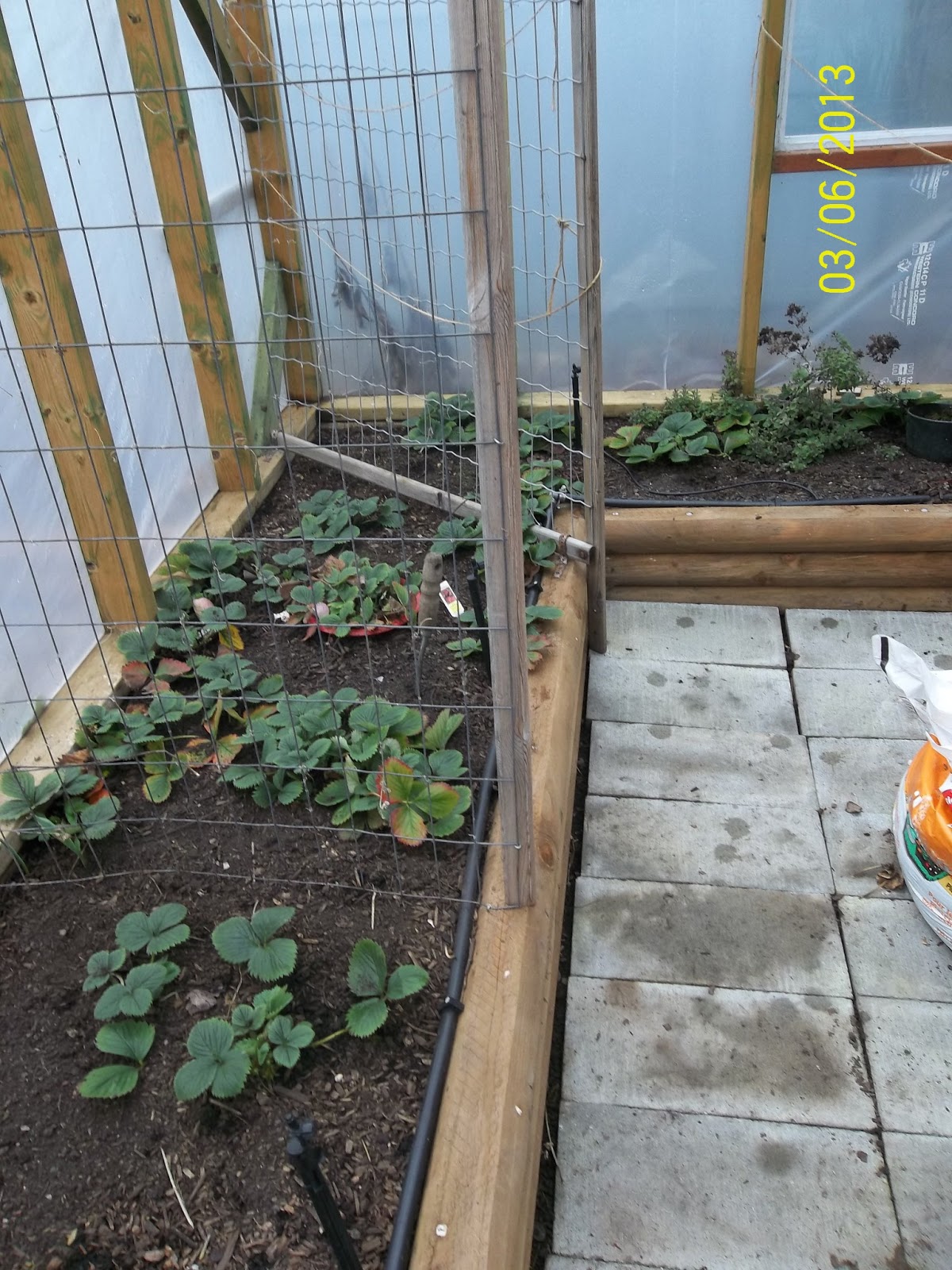
My strawberry plants inside the greenhouse (unheated) have some flower buds on them and they produced a load of runners so I will have lots of plants this year.  

* * *


The outside strawberry plants look nice and healthy and also produced an abundance of runners so I think I will be giving plants way soon.  If you look closely you can see the acorns all over the place.  As soon as it is dry enough I will be cleaning up all the dead leaves and sorting out which plants to keep and which to give away.  (I am sure the rain will soon stop long enough for the ground to dry up a bit!)

* * *


Speaking of the greenhouse, the one thing that is in there that always does extremely well is the "Egyptian Onions" aka Walking Onions.  I have them in the greenhouse so we can have early green onions.  The bulblets I planted last fall are now at a size they can be harvested. We don't use a lot of green onions so we don't have a big planting - just enough to use a few now and then.   The main plant itself has more than doubled in size and the nice thing is they don't really need to be inside a greenhouse as they will survive nicely over the winter in areas with sub-zero temperatures.  The small onions at the bottom of the picture are just about ready - a little bigger would be OK but small is nice.

* * *

One other thing that did well is the Oak trees in the neighbour's yards.  Yes, I said "yards" - 3 or 4 trees on the south and a huge one on the north - all of them were raining acorns on us last fall and now there are many dozen sprouting all over the place.  In case anyone is interested in growing more Gary Oak trees (endangered species) I have offered the sprouted acorns on our local freecycle/recycle group.

http://groups.yahoo.com/group/cowichanvalleyrecycle/
Many interesting offerings by the group - everything from plants to boats, and it all has to be given away free.  Last fall I gave away a couple of buckets of acorns - one to a lady whose 2 little girls wanted them to feed to the squirrels, the other to a lady who was going to process them into acorn flour.

* * *

 Last fall I left a lot of the oak & maple leaves on the ground in the flower beds - good mulch, and it did it's job so our plants that were covered are now sprouting up nicely.  I raked up the leaves now so insects can't multiply under them, have heaped them on my compost pile in hopes they will eventually rot down. The heather, oriental poppies and day lillies are looking good.

* * *


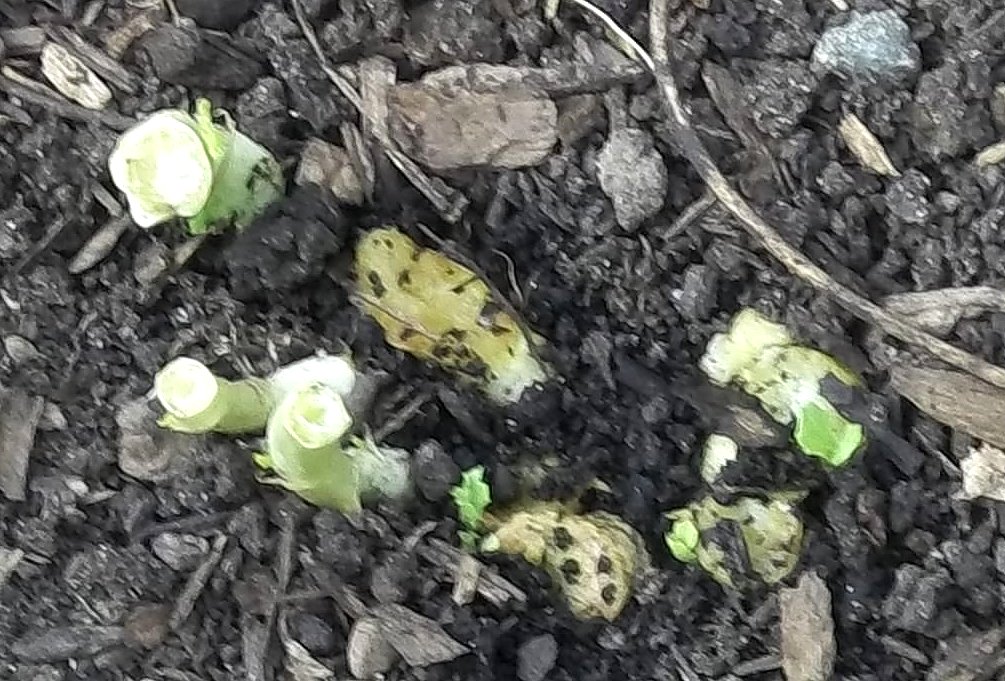
The raspberry canes have overwintered and thrived.  They do send out shoots for new canes and I notice that two shoots have found their way under the wall of the greenhouse and have come up in there.  (you have to look closely to see them!) Those will be dug up and offered to anyone needing them - on "Freecycle" of course!

* * *


While we were away, the people taking care of our place planted some lettuce... a different variety than we normally grow so we will see how it does. We normally plant a few plants of baby butter from seed.  Just a few seeds planted every couple of weeks can give you a steady supply.

* * *


Talk about a strange looking sight!  I planted some Oregano late last summer and it seems to like the location.  Every branch that touched the ground has sent out roots so this mess can be divided up into a number of plants.  The strawberries were not really invited but the runners just grew all over the place.  If they produce well, then maybe they will get to stay in the place the chose.  In the black pot is a cutting that has rooted OK and is sprouting.  When it gets a little larger maybe we will be able to figure out what we were trying to grow.   One of the problems that comes with age is not remembering what the heck you planted!

 * * *


Thursday, 4 October 2012

Winterizing

Winterizing

 Here on Vancouver Island the weather has been spectacular.  Dry Dry Dry  -  so dry there is a big problem with the amount of water in the Cowichan River.  Warmest, driest August and September on record!  Thanksgiving weekend is coming up here in Canada and it is going to be sunny and then more sun for about another week or so.  At least that is what the weatherman tells us.
With clear skies the temperature drops - especially overnight.  So it is time to start planning for the freezing weather which we are getting a taste of these nights.  Soon it will be freezing harder and lots of damage can be done if the cold is ignored.

As plants die down or are killed by the frost it is important to clean up the debris quickly.  You don't want to leave it laying around for bugs to hide under protected from the cold.

If you have a compost pile, check to see if it is moist or dry.  If too dry it will take too long to break down into compost so you may have to wet it down a bit.  If you are putting leaves in the compost  just keep in mind some types break down very slowly unless they are chopped up.  This is often done the easy way by picking them up with a lawnmower.  If you ave a shredder/chopper that works well for all types of leaves, twigs & small branches, but even on sale a small one is quite expensive.  If you don't have a shredder cut things like corn stalks into short pieces, preferably cutting between each segment so the bacteria can break the stalk down easier.  And don't forget to "turn the pile" - stir it up!

Something new in our area is another recycling step.  We now have a special green bin and all kitchen scraps including bones, fat, greasy cardboard (pizza boxes) go into this and is picked up every week.  This is in addition to the regular recycle bin/can picked up every second week which contains clean plastic, tins & paper.  This kitchen scrap material is taken away and composted and the resulting compost material will be used or sold.  We can now use our compost bin in the garden for plant material and vegetable peelings which don't attract rodents as badly as fruit residue does.

Time to take a really close look at the plants in your garden and decide which ones will not winter over and of those, which ones you want to take inside for the winter.  Some plants and shrubs will overwinter when given some protection like a burlap wrap or for low plants a covering of leaves.  If you are unsure, then go online and check to see what is recommended for the plants your have.  Keep in mind that plants brought inside for the winter - possibly in a heated greenhouse or warm basement - will require less watering than when outside.

Do you save seeds from your garden?  If you do, inspect them carefully for insect damage so you don't accidentally keep the nasties for next year.  Seeds from many flowers will do well next year but keep in mind if the plant is a hybrid then the seed may revert back to something not as nice.  And when it comes to vegetable seeds you can also get cross pollinization.  One year my compost gave me a nice plant that I was sure was from zucchini seeds but when I grew it, it had a vine instead of a bush type plant and the fruit was a cross between zucchini and spaghetti squash.  It was OK but different - it looked like zucchini but the meat inside was in strands like spaghetti.  

And then there are the "volunteers".   I have had good success with volunteer cherry tomatoes in the greenhouse.  They grew from seeds in tomatoes that had dropped off & broke down over the winter.  Again, they may not come "true to type" or in other words they may not be quite like the ones the seed came from.

Time to do the late fall mowing of the lawn and once you have
that done, take a look at your outside faucets and garden hoses.
Disconnect all hoses, drain them and store them for the winter.
This is very important if you have "frost proof" taps/faucets as
the hose could be full of water or partly full, which will mean there
is water between the outside portion of the faucet and the shut-off inside the house.  I made that mistake one year - had a hose that
was connected to the tap and it froze quite hard overnight. 
It didn't hurt the hose but the tap/faucet froze and split.
Even with the "frost proof" type faucet I still like to provide an 
extra layer of protection by using strofoam caps over the taps.

That should have the main work done down to a point that you can now do a cleanup of all flower & vegetable beds.  
And that means HARD LABOUR ...

Keep the linament handy, you might need it, but don't overdo it and injure yourself.  It sure doesn't have to be done all at once!

Keep well
GG


Sunday, 30 September 2012

Pre-winter Cleanup

Pre-Winter Cleanup


The days are getting shorter, less daylight means less heat and the plants are fading away.  In the greenhouse I have cut back the tomato plants to leave just enough to support the last few tomatoes of the year.  Any green ones left will soon be harvested and stored to ripen slowly.  
 My grandpa & Granny Delcourt used to wrap their late green tomatoes in newspaper and store them in boxes to ripen.  The problem with doing that is the need to check once or twice a week to see which ones are ripe enough and also to check for any going bad.  I have  found it is really not necessary to wrap & box them - just put them on cardboard or layers of newspaper a shelf in a cool place and  make sure they are not touching each other.  You can then just walk past and choose the ones that are ripe enough or get rid of any going bad.  
I was going to pull out the purple bush beans but they are still trying to give us a few beans so I will wait until they are finished then pull them up and dig up the soil.  
The carrots are OK where they are until we are ready for them.  They last quite well in the soil as long as there are no bugs eating them.
 From left to right - the edge of the carrot patch, some of the purple bush beans, the new growth of peas and the mass of strawberry runners.


My Egyptian onions (aka Walking Onions - as mentioned on previous blog page) are doing great.  I did pick all the little onion bulblets and planted them out 2 or 3 weeks ago.  They have sprouted up and are doing very nicely.  As a matter of fact a couple that I had planted about a month ago were large enough to pick as green onions, which we did harvest today.


The outside garden looks very barren compared to what it was a month or two ago.  All the squash vines are in the compost as are the bean vines.  Some of the beans that I didn't pull up but only broke them off have re-sprouted and are trying to start all over again.  We will soon be having frost which will do them in.   Next it will be time to turn over the soil for winter, and I guess I will find out if the acorns that are raining down from the big Oak Tree are going to sprout or just become organic boost for the soil.  The picture below is the big Oak Tree that rains acorns and leaves down on the shed & greenhouse.  When the acorns hit the shed roof it sounds like someone is attacking with a sling shot!


The flower garden at the front of the house has been trimmed back some as some of the petunias were taking over and looking a bit weary.  In their place we have put in some chrysanthemums and the one we planted in the spring is getting ready to bloom.  It will soon be time to take out all the annuals and clean up the beds for winter.  Don't want to leave any trash on the surface for bugs to hide under.

The salmon pink geranium is one huge plant, and the purple petunia is also just one huge plant.  The white Alyssum were just a few small plants in spring but nearly took over the whole bed.

 
Another chore I am not looking forward to is moving our peony plant.  It is hidden behind the end of the greenhouse and is going to be moved to where a hydrangea has been removed.  It didn't do very well so we decided it would be nicer to have the peony out where we can see it. 


Of course there is another problem to deal with - leaves, leaves & more leaves, plus acorns raining down constantly.  When the acorns hit the shed roof it sounds like someone is attacking with a sling shot!  I have found the best way to pick them up is with an aluminum scoop shovel as a rake just doesn't work.  There are at least 3 or 4 Oak trees and a few Maple trees - of course they are the kind with giant leaves.    

The Times Colonist newspaper today (August 30th) stated that August and September were the driest on record.  And the forecast for the next 10 days or so promises more of the same.  When the rains finally come ... they probably won't know when to quit.

The temperature is bound to start dropping soon so it will be time to drain the garden hoses and shut off all outside faucets, then have the irrigation system winterized.  

Regards to all
GG


Sunday, 23 September 2012

Fall Harvest

* Fall Harvest *
And what do you do with all that bounty?

So you had a good growing season and you have produce that you really don't know what to do with.  I am sure many people would love to have that problem.  
As mentioned in previous blogs, there has been a lot of fruit that is being shared through "Cowichan Valley Recycle".  The group operating this site is doing a fantastic job of trying to get people to offer things for free instead of just throwing them away.  Like they say, "one person's trash is another person's treasure" - and some of the items offered by people are weird and/or wonderful.  The website address is -  http://groups.yahoo.com/group/cowichanvalleyrecycle/

Another way of sharing the bounty is offering fruit & veggies to the food bank or to your local senior's centre.  Many seniors have had to move into apartments or condos as they are no longer able to look after gardens, and they really appreciate fresh produce.

OK OK - it is a terrible picture, fuzzy, out of focus due to me not checking the camera settings.  And we ate the biggest one before
I realized the problem.
The biggest tomato in the picture was
17 ounces / a bit over 500 grams.
And it was delicious! 
The remainder will be cut up & preserved.

 I let some of the scarlet runner beans go to seed, the pods shown are drying out and the seed saved for next year.  I will have enough that I will be offering some seeds to anyone on Recycle that wants them.  Many of the beans were over a foot long, but are best picked before the beans start forming inside the pod.
 * * *

 Well, the squash did OK - 2 are missing from the lineup, having been picked & devoured.
The variety is "Sweet Meat", the largest in the picture is about 10" across and 12 lbs.
Janet (gramma & wife) cuts the squash into pieces about 1 2/2" or 40mm in size, trims the hard skin off, steams the pieces then puts them in a pan with brown sugar & butter and bakes them.  They come out tasting like sweet potatoes.
* * *
So that takes us to the abundance of apples and plums, and all the work that was done - as was mentioned on the last blog.  The following will give you a bit of an idea of what was accomplished. 


Jams & Jellies lined up 

all nicely trimmed

ready for Ashley's sale.
 

Complete display 
of all the various items
Ashley made, often with a little
help from "Gramma"

Apple Sauce
Apple Jelly
Apply pie filling 
Apple Butter
Plum Jam
Plum Jelly 
Raspberry Jam
Raspberry Jelly
Blackberry Jam
Blackberry Jelly 


Outside bake sales are 

not always fun

as Ashley found out!


Once you get a bit more organized  

and established things work out a 

bit better.


Another day

Another display

 of "Yummies by Ashley"


with pastry so tender

it melts in your mouth!


* * *
So - now it is up to you!
If you have the produce, time, energy and a little initiative,
you too can cook/bake up a storm and make a little extra money.  

* * *
GG